Classes | |
| class | Conic |
| A conic section represented by a symmetric 3x3 matrix. More... | |
| struct | Fraction |
| Fraction. More... | |
| class | Involution |
| class | involution_generic |
| Generic involution class for projective planes. More... | |
| class | persp_euclid_plane |
| Perspective-Euclidean plane class. More... | |
| struct | pg_line |
| Projective line: two dimensional subspace of K^3. More... | |
| struct | pg_object |
| Generic projective geometry object (value-type templated) More... | |
| struct | pg_point |
Concepts | |
| concept | CayleyKleinPlanePrimitive |
| Cayley-Klein plane Concept. | |
| concept | CayleyKleinPlanePrimitiveDual |
| Cayley-Klein plane Concept (full) | |
| concept | CayleyKleinPlane |
| Cayley-Klein plane Concept. | |
| concept | CayleyKleinPlaneDual |
| Cayley-Klein plane Concept (full) | |
| concept | Sequence |
| Sequence. | |
| concept | Ring |
| Ring concept. | |
| concept | OrderedRing |
| Ordered ring concept. | |
| concept | Integral |
| Integral concept. | |
| concept | ProjectivePlanePrimitive |
| Projective plane Concept. | |
| concept | ProjPlanePrimDual |
| Projective plane Concept (full) | |
| concept | ProjectivePlane |
| Projective plane Concept. | |
| concept | ProjectivePlaneDual |
| Projective plane dual Concept. | |
| concept | ProjectivePlanePrimH |
| Projective plane Concept (half) | |
| concept | ProjectivePlanePrim |
| Projective plane Concept (full) | |
| concept | ProjectivePlanePrim2 |
| Shorthand Notation of ProjectivePlane. | |
| concept | ProjectivePlaneGenericH |
| Projective plane Concept (full) | |
| concept | ProjectivePlaneGeneric |
| Projective plane Concept (full) | |
| concept | ProjectivePlaneGeneric2 |
| Shorthand Notation of ProjectivePlane. | |
| concept | ProjectivePlaneH |
| Projective plane Concept (half) | |
| concept | ProjectivePlane2 |
| Shorthand Notation of ProjectivePlane. | |
| concept | ProjectivePlaneCoordH |
| Projective plane Concept (half) | |
| concept | ProjectivePlaneCoord |
| Projective plane Concept (full) | |
| concept | ProjectivePlaneCoord2 |
| Shorthand Notation of ProjectivePlane. | |
Typedefs | |
| template<typename T > | |
| using | Value_type = typename T::value_type |
| Value type of a type. | |
| template<typename T > | |
| using | Element_type = typename std::decay< decltype(back(std::declval< T >()))>::type |
| Element type of a sequence. | |
| template<typename Point > | |
| using | Triple = std::array< Point, 3 > |
| Type alias for an array of three points (a triangle) | |
Enumerations | |
| enum class | ConicType { Ellipse , Parabola , Hyperbola } |
| Enumeration of conic types based on the discriminant. More... | |
Functions | |
| template<class Line , class Point = typename Line::Dual> | |
| constexpr auto | is_perpendicular (const Line &l_1, const Line &l_2) -> bool |
| Check if two lines are perpendicular (Cayley-Klein). | |
| template<class Point , class Line > | |
| constexpr auto | altitude (const Point &pt_p, const Line &ln_m) -> Line |
| Compute the altitude from a point to a line (Cayley-Klein). | |
| template<class Point , class Line = typename Point::Dual> | |
| constexpr auto | orthocenter (const std::array< Point, 3 > &triangle) -> Point |
| Compute the orthocenter of a triangle (Cayley-Klein). | |
| template<class Point , class Line > | |
| constexpr auto | tri_altitude (const std::array< Point, 3 > &triangle) -> std::array< Line, 3 > |
| Compute all three altitudes of a triangle (Cayley-Klein). | |
| template<typename Value , class Point , class Line = typename Point::Dual> | |
| constexpr auto | reflect (const Line &mirror, const Point &pt_p) -> Point |
| Reflect a point across a line (Cayley-Klein). | |
| template<ProjectivePlaneCoord2 Line> | |
| constexpr auto | fB (const Line &line_l) -> typename Line::Dual |
| Convert a line to its direction vector in the affine plane. | |
| template<ProjectivePlaneCoord2 Line> | |
| constexpr auto | is_perpendicular (const Line &line_l, const Line &line_m) -> bool |
| Check if two lines are perpendicular. | |
| template<ProjectivePlaneCoord2 Line> | |
| constexpr auto | is_parallel (const Line &line_l, const Line &line_m) -> bool |
| Check if two lines are parallel. | |
| template<typename Point , typename Line > requires ProjectivePlaneCoord<Point, Line> | |
| constexpr auto | altitude (const Point &a, const Line &line_l) -> Line |
| Compute the altitude from a point to a line. | |
| template<ProjectivePlaneCoord2 Point> | |
| constexpr auto | tri_altitude (const Triple< Point > &triangle) |
| Compute all three altitudes of a triangle. | |
| template<ProjectivePlaneCoord2 Point> | |
| constexpr auto | orthocenter (const Triple< Point > &triangle) -> Point |
| Compute the orthocenter of a triangle. | |
| template<ProjectivePlaneCoord2 Line> | |
| constexpr auto | reflect (const Line &line_m) |
| Create an involution that reflects across a line. | |
| template<ProjectivePlaneCoord2 Point> | |
| constexpr auto | midpoint (const Point &a, const Point &b) -> Point |
| Compute the midpoint of two points. | |
| template<ProjectivePlaneCoord2 Point> | |
| constexpr auto | tri_midpoint (const Triple< Point > &triangle) -> Triple< Point > |
| Compute the midpoints of all three sides of a triangle. | |
| template<ProjectivePlaneCoord2 Point> | |
| constexpr auto | uc_point (const Value_type< Point > &lda1, const Value_type< Point > &mu1) |
| Compute a point on the unit circle from trigonometric parameters. | |
| template<OrderedRing _Q> | |
| constexpr auto | archimedes (const _Q &a, const _Q &b, const _Q &c) |
| Archimedes's function. | |
| template<typename _Q > | |
| constexpr auto | cqq (const _Q &a, const _Q &b, const _Q &c, const _Q &d) -> std::array< _Q, 2 > |
| Cyclic quadrilateral quadrea theorem. | |
| template<typename T > | |
| constexpr auto | Ptolemy (const T &quad) -> bool |
| Check Ptolemy's theorem for a cyclic quadrilateral. | |
| template<typename K > requires Integral<K> | |
| constexpr auto | quad1 (const K &x1, const K &z1, const K &x2, const K &z2) |
| Compute squared difference of ratios (integral version). | |
| template<typename K > | |
| constexpr auto | quad1 (const K &x1, const K &z1, const K &x2, const K &z2) |
| Compute squared difference of ratios (non-integral version). | |
| template<ProjectivePlaneCoord2 Point> | |
| constexpr auto | quadrance (const Point &a1, const Point &a2) |
| Compute the quadrance between two points. | |
| template<typename... Args> | |
| constexpr auto | quadrance_copy (const Args &... args) |
| Compute quadrances for multiple pairs of points. | |
| template<ProjectivePlaneCoord2 Line, typename T > | |
| constexpr auto | sbase (const Line &l1, const Line &l2, const T &d) |
| Base function for spread and cross-spread. | |
| template<ProjectivePlaneCoord2 Line> | |
| constexpr auto | spread (const Line &l1, const Line &l2) |
| Compute the spread between two lines. | |
| template<ProjectivePlaneCoord2 Point> | |
| constexpr auto | tri_quadrance (const Triple< Point > &triangle) |
| Compute the quadrances of a triangle's sides. | |
| template<ProjectivePlaneCoord2 Line> | |
| constexpr auto | tri_spread (const Triple< Line > &trilateral) |
| Compute the spreads of a triangle's angles. | |
| template<ProjectivePlaneCoord2 Line> | |
| constexpr auto | cross_s (const Line &l1, const Line &l2) |
| Compute the cross spread between two lines. | |
| template<typename T > | |
| constexpr auto | abs (const T &a) -> T |
| absolute | |
| template<Integral Mn> | |
| constexpr auto | gcd_recur (const Mn &_m, const Mn &_n) -> Mn |
| Greatest common divider. | |
| template<Integral Mn> | |
| constexpr auto | gcd (const Mn &_m, const Mn &_n) -> Mn |
| Greatest common divisor. | |
| template<Integral Mn> | |
| constexpr auto | lcm (const Mn &_m, const Mn &_n) -> Mn |
| Least common multiple. | |
| template<Ring _K> | |
| auto | cross0 (const std::array< _K, 3 > &v_a, const std::array< _K, 3 > &v_b) -> _K |
| 1st term of Cross product (yz-plane projection) | |
| template<Ring _K> | |
| auto | cross1 (const std::array< _K, 3 > &v_a, const std::array< _K, 3 > &v_b) -> _K |
| 2nd term of Cross product (xz-plane projection) | |
| template<Ring _K> | |
| auto | cross2 (const std::array< _K, 3 > &v_a, const std::array< _K, 3 > &v_b) -> _K |
| 3rd term of Cross product (xy-plane projection) | |
| template<typename Point > requires Ring<Value_type<Point>> | |
| auto | cross (const Point &v_a, const Point &v_b) -> std::array< Value_type< Point >, 3 > |
| Cross product in homogeneous 3D coordinates. | |
| template<Ring _K> | |
| auto | dot_c (const std::array< _K, 3 > &v_a, const std::array< _K, 3 > &v_b) -> _K |
| Dot product (full 3-component) | |
| template<Ring _T, Ring _K> | |
| auto | plucker_c (const _T &lambda_val, const std::array< _K, 3 > &v_a, const _T &mu_val, const std::array< _K, 3 > &v_b) -> std::array< _K, 3 > |
| generic Plücker linear combination | |
| template<Ring _K> | |
| auto | dot1 (const std::array< _K, 3 > &v_a, const std::array< _K, 3 > &v_b) -> _K |
| Dot product of the (x,y)-components of two vectors (affine part) | |
| template<Ring _K> | |
| auto | dot2 (const std::array< _K, 3 > &v_a, const std::array< _K, 3 > &v_b) -> _K |
| Dot product of the (0,2)-component of two vectors. | |
| template<typename T > | |
| constexpr auto | sq (const T &a) |
| Square function. | |
| template<typename Value , typename Point > requires Ring<Value> | |
| constexpr auto | parametrize (const Value &lambda_val, const Point &pt_p, const Value &mu_val, const Point &pt_q) -> Point |
| Homogeneous parametrization of point or line (free function) | |
| template<Ring _K> | |
| constexpr auto | meet (const pg_line< _K > &ln_l, const pg_line< _K > &ln_m) -> pg_point< _K > |
| template<class Point , class Line > | |
| auto | check_axiom (const Point &pt_p, const Point &pt_q, const Line &ln_l) -> bool |
| Check Projective plane Axiom. | |
| template<class Point , class Line = typename Point::Dual> | |
| constexpr auto | coincident (const Point &pt_p, const Point &pt_q, const Point &pt_r) -> bool |
| Coincident. | |
| template<class Point , class Line = typename Point::Dual> | |
| constexpr auto | check_pappus (const std::array< Point, 3 > &coline1, const std::array< Point, 3 > &coline2) -> bool |
| Check Pappus Theorem. | |
| template<class Point , class Line = typename Point::Dual> | |
| constexpr auto | tri_dual (const std::array< Point, 3 > &triangle) -> std::array< Line, 3 > |
| Dual of triangle. | |
| template<class Point , class Line = typename Point::Dual> | |
| constexpr auto | persp (const std::array< Point, 3 > &tri1, const std::array< Point, 3 > &tri2) -> bool |
| return whether two triangles are perspective | |
| template<class Point , class Line = typename Point::Dual> | |
| constexpr auto | check_desargue (const std::array< Point, 3 > &tri1, const std::array< Point, 3 > &tri2) -> bool |
| Check Desargue's Theorem. | |
| template<typename Value , class Point , class Line > | |
| auto | check_axiom2 (const Point &pt_p, const Point &pt_q, const Line &ln_l, const Value &a, const Value &b) -> bool |
| Check Axiom 2 for extended projective plane properties. | |
| template<typename Value , class Point , class Line = typename Point::Dual> | |
| constexpr auto | harm_conj (const Point &pt_a, const Point &pt_b, const Point &pt_c) -> Point |
| Harmonic conjugate. | |
| template<typename Value , class Point , class Line > | |
| constexpr auto | involution (const Point &origin, const Line &mirror, const Point &pt_p) -> Point |
| Involution on a point. | |
| template<Ring _K> | |
| constexpr auto | join (const pg_point< _K > &pt_p, const pg_point< _K > &pt_q) -> pg_line< _K > |
| Return the join (product) of two points to form a line. | |
| template<typename Point , typename Line > requires ProjectivePlane<Point, Line> | |
| constexpr auto | incident (const Point &pt_p, const Line &ln_l) -> bool |
The code snippet is defining a function named incident that checks if a point pt_p is incident to a line ln_l in a projective plane. The function uses the dot method of the Point class and compares it to zero to determine if the point is incident to the line. The function returns a boolean value indicating whether the point is incident to the line or not. | |
| template<typename Line , typename... Args> requires (ProjectivePlanePrim<Line, Args> && ...) | |
| constexpr auto | coincident (const Line &ln_l, const Args &... pt_r) -> bool |
| Coincident. | |
| template<ProjectivePlanePrim2 Point> | |
| constexpr auto | tri_dual (const Triple< Point > &triangle) |
| Compute the dual triangle (sides as points). | |
| template<ProjectivePlanePrim2 Point, typename Fn > | |
| constexpr auto | tri_func (Fn &&func, const Triple< Point > &triangle) |
| Apply a binary function to all pairs of triangle vertices. | |
| template<ProjectivePlanePrim2 Point> | |
| constexpr auto | persp (const Triple< Point > &tri1, const Triple< Point > &tri2) -> bool |
| return whether two triangles are perspective | |
| template<ProjectivePlane2 Point> | |
| constexpr auto | harm_conj (const Point &A, const Point &B, const Point &C) -> Point |
| Compute the harmonic conjugate of three collinear points. | |
| template<ProjectivePlaneGeneric2 _Point> | |
| constexpr auto | harm_conj (const _Point &A, const _Point &B, const _Point &C) -> _Point |
| Compute the harmonic conjugate (generic version). | |
| template<ProjectivePlane2 Point> | |
| constexpr auto | is_harmonic (const Point &A, const Point &B, const Point &C, const Point &D) -> bool |
| Check if four points form a harmonic range. | |
| template<ProjectivePlanePrim2 Point> | |
| void | check_pappus (const Triple< Point > &coline1, const Triple< Point > &coline2) |
| Check Pappus Theorem for two sets of collinear points. | |
| template<ProjectivePlanePrim2 Point> | |
| void | check_desargue (const Triple< Point > &tri1, const Triple< Point > &tri2) |
| Check Desargues' theorem for two triangles. | |
| template<Ring K> | |
| constexpr auto | ratio_ratio (const K &a, const K &b, const K &c, const K &d) |
| Compute the ratio of two ratios. | |
| template<typename Point , typename Line > requires ProjectivePlane<Point, Line> | |
| constexpr auto | x_ratio (const Point &A, const Point &B, const Line &line_l, const Line &line_m) |
| Cross Ratio. | |
| template<ProjectivePlaneCoord2 Point> | |
| constexpr auto | R (const Point &A, const Point &B, const Point &C, const Point &D) |
| Compute the cross ratio of four collinear points. | |
| template<ProjectivePlaneCoord2 Point> | |
| constexpr auto | R0 (const Point &A, const Point &B, const Point &C, const Point &D) |
| Compute cross ratio using yz-plane projection. | |
| template<ProjectivePlaneCoord2 Point> | |
| constexpr auto | R1 (const Point &A, const Point &B, const Point &C, const Point &D) |
| Compute cross ratio using xz-plane projection. | |
Detailed Description
Typedef Documentation
◆ Element_type
| using fun::Element_type = typedef typename std::decay<decltype(back(std::declval<T>()))>::type |
Element type of a sequence.
Extracts the element type from a sequence container by examining the type returned by the back() method.
- Template Parameters
-
T A sequence type supporting back()
◆ Triple
| using fun::Triple = typedef std::array<Point, 3> |
Type alias for an array of three points (a triangle)
- Template Parameters
-
Point The point type
◆ Value_type
| using fun::Value_type = typedef typename T::value_type |
Value type of a type.
Extracts the value_type member type from a type if it exists.
- Template Parameters
-
T A type with a value_type member
Enumeration Type Documentation
◆ ConicType
|
strong |
Function Documentation
◆ abs()
|
constexpr |
absolute
- Template Parameters
-
T
- Parameters
-
[in] a
- Returns
- T
◆ altitude() [1/2]
requires ProjectivePlaneCoord<Point, Line>
|
constexpr |
Compute the altitude from a point to a line.
The altitude is the line through the given point that is perpendicular to the given line.
\[ h_a = a \times \bar{l} \]
where \(\bar{l}\) is the direction vector of line \(l\).
- Parameters
-
[in] a The point from which the altitude is drawn [in] line_l The line to which the altitude is drawn
- Returns
- Line The altitude line
◆ altitude() [2/2]
|
constexpr |
Compute the altitude from a point to a line (Cayley-Klein).
Uses the pole-polar relationship to compute the altitude.
- Template Parameters
-
Point The point type \[ h = m^\perp \times p \]
where \(m^\perp\) is the polar of the line.Point The point type Line The line type
◆ archimedes()
|
constexpr |
Archimedes's function.
\[ \mathrm{archimedes}(a,b,c) = 4ab - (a + b - c)^2 \]
- Template Parameters
-
_Q
- Parameters
-
[in] a [in] b [in] c
- Returns
- auto
◆ check_axiom()
|
inline |
Check Projective plane Axiom.
- Template Parameters
-
Point Point Line Line
- Parameters
-
[in] pt_p [in] pt_q [in] ln_l
◆ check_axiom2()
|
inline |
Check Axiom 2 for extended projective plane properties.
- Template Parameters
-
Value The value/coordinate type Point The point type Line The line type (dual of point)
- Parameters
-
[in] pt_p First point [in] pt_q Second point [in] ln_l A line [in] a First parameter value [in] b Second parameter value
◆ check_desargue() [1/2]
|
constexpr |
Check Desargue's Theorem.
- Template Parameters
-
Point Point
- Parameters
-
[in] tri1 [in] tri2
- Returns
- true
- false
◆ check_desargue() [2/2]
| void fun::check_desargue | ( | const Triple< Point > & | tri1, |
| const Triple< Point > & | tri2 | ||
| ) |
Check Desargues' theorem for two triangles.
Asserts that two triangles are perspective from a point if and only if they are perspective from a line. This is a fundamental theorem in projective geometry.
- Parameters
-
[in] tri1 First triangle [in] tri2 Second triangle
◆ check_pappus() [1/2]
|
constexpr |
Check Pappus Theorem.
- Template Parameters
-
Point Point
- Parameters
-
[in] coline1 [in] coline2
- Returns
- true
- false
◆ check_pappus() [2/2]
| void fun::check_pappus | ( | const Triple< Point > & | coline1, |
| const Triple< Point > & | coline2 | ||
| ) |
Check Pappus Theorem for two sets of collinear points.
Asserts that the three intersection points formed by joining corresponding points from two collinear triples are themselves collinear.
- Parameters
-
[in] coline1 First triple of collinear points [in] coline2 Second triple of collinear points
◆ coincident() [1/2]
requires (ProjectivePlanePrim<Line, Args> && ...)
|
constexpr |
Coincident.
- Template Parameters
-
Line Line Args points
- Returns
- true if points are conincident (on a line ln_l)
- false otherwise
◆ coincident() [2/2]
|
constexpr |
Coincident.
- Template Parameters
-
Point
- Parameters
-
[in] pt_p [in] pt_q [in] pt_r
- Returns
- true
- false
◆ cqq()
|
constexpr |
Cyclic quadrilateral quadrea theorem.
Returns the coefficients of the quadratic equation whose roots are the quadrea of a cyclic quadrilateral with opposite sides (a,b) and (c,d).
\[ Q^2 - (4ab + 4cd - (a+b-c-d)^2)\,Q + 16abcd = 0 \]
- Template Parameters
-
_Q
- Parameters
-
[in] a [in] b [in] c [in] d
- Returns
- auto
◆ cross()
requires Ring<Value_type<Point>>
| auto fun::cross | ( | const Point & | v_a, |
| const Point & | v_b | ||
| ) | -> std::array<Value_type<Point>, 3> |
Cross product in homogeneous 3D coordinates.
\[ v_a \times v_b = \begin{pmatrix} v_{a,y} v_{b,z} - v_{b,y} v_{a,z} \\ v_{b,x} v_{a,z} - v_{a,x} v_{b,z} \\ v_{a,x} v_{b,y} - v_{b,x} v_{a,y} \end{pmatrix} \]
- Template Parameters
-
_K
- Parameters
-
[in] v_a [in] v_b
- Returns
- Cross product
◆ cross0()
| auto fun::cross0 | ( | const std::array< _K, 3 > & | v_a, |
| const std::array< _K, 3 > & | v_b | ||
| ) | -> _K |
1st term of Cross product (yz-plane projection)
\[ \mathrm{cross}_0(v,w) = v_y w_z - w_y v_z \]
- Template Parameters
-
_K
- Parameters
-
[in] v [in] w
- Returns
- 1st term of Cross product
◆ cross1()
| auto fun::cross1 | ( | const std::array< _K, 3 > & | v_a, |
| const std::array< _K, 3 > & | v_b | ||
| ) | -> _K |
2nd term of Cross product (xz-plane projection)
\[ \mathrm{cross}_1(v_a,v_b) = v_{a,x} v_{b,z} - v_{b,x} v_{a,z} \]
- Template Parameters
-
_K
- Parameters
-
[in] v_a [in] v_b
- Returns
- 2nd term of Cross product
◆ cross2()
| auto fun::cross2 | ( | const std::array< _K, 3 > & | v_a, |
| const std::array< _K, 3 > & | v_b | ||
| ) | -> _K |
3rd term of Cross product (xy-plane projection)
\[ \mathrm{cross}_2(v_a,v_b) = v_{a,x} v_{b,y} - v_{b,x} v_{a,y} \]
- Template Parameters
-
_K
- Parameters
-
[in] v_a [in] v_b
- Returns
- 3rd term of Cross product
◆ cross_s()
|
constexpr |
Compute the cross spread between two lines.
The cross spread is the squared cosine of the angle between lines:
\[ \mathrm{cross\_s}(l_1, l_2) = \frac{\mathrm{dot}_1(l_1, l_2)^2} {\mathrm{dot}_1(l_1, l_1) \mathrm{dot}_1(l_2, l_2)} \]
- Parameters
-
[in] l1 First line [in] l2 Second line
- Returns
- auto The cross spread
◆ dot1()
| auto fun::dot1 | ( | const std::array< _K, 3 > & | v_a, |
| const std::array< _K, 3 > & | v_b | ||
| ) | -> _K |
Dot product of the (x,y)-components of two vectors (affine part)
\[ \mathrm{dot}_1(v_a,v_b) = v_{a,x} v_{b,x} + v_{a,y} v_{b,y} \]
- Template Parameters
-
_K
- Parameters
-
[in] v_a [in] v_b
- Returns
- auto
◆ dot2()
| auto fun::dot2 | ( | const std::array< _K, 3 > & | v_a, |
| const std::array< _K, 3 > & | v_b | ||
| ) | -> _K |
Dot product of the (0,2)-component of two vectors.
\[ \mathrm{dot}_2(v_a,v_b) = v_{a,x} v_{b,x} + v_{a,z} v_{b,z} \]
- Template Parameters
-
_K
- Parameters
-
[in] v_a [in] v_b
- Returns
- auto
◆ dot_c()
| auto fun::dot_c | ( | const std::array< _K, 3 > & | v_a, |
| const std::array< _K, 3 > & | v_b | ||
| ) | -> _K |
Dot product (full 3-component)
\[ v_a \cdot v_b = v_{a,x} v_{b,x} + v_{a,y} v_{b,y} + v_{a,z} v_{b,z} \]
- Template Parameters
-
_K
- Parameters
-
[in] v_a [in] v_b
- Returns
- auto
◆ fB()
|
constexpr |
Convert a line to its direction vector in the affine plane.
Extracts the direction components (first two coordinates) of a line, effectively treating the line as a direction vector in the Euclidean plane.
- Parameters
-
[in] line_l The line to extract direction from
- Returns
- The dual type representing the direction vector
◆ gcd()
|
constexpr |
Greatest common divisor.
\[ \gcd(m,n) = \begin{cases} |n| & \text{if } m = 0 \\ \gcd(|m|, n \bmod |m|) & \text{otherwise} \end{cases} \]
- Template Parameters
-
Mn
- Parameters
-
[in] _m [in] _n
- Returns
- Mn
◆ gcd_recur()
|
constexpr |
Greatest common divider.
- Template Parameters
-
Mn
- Parameters
-
[in] _m [in] _n
- Returns
- Mn
◆ harm_conj() [1/3]
|
constexpr |
Compute the harmonic conjugate (generic version).
Given three collinear points A, B, C, returns the fourth point D such that (A, B; C, D) is a harmonic range. Generic version using auxiliary constructions.
\[ D = (Q \times S) \times AB \]
where \(P = AB^\perp\), \(R = P^\perp(C)\), \(S = (A \times R) \times (B \times P)\), \(Q = (B \times R) \times (A \times P)\).
- Parameters
-
[in] A First point [in] B Second point [in] C Third point (must be collinear with A and B)
- Returns
- constexpr Point The harmonic conjugate
◆ harm_conj() [2/3]
|
constexpr |
Compute the harmonic conjugate of three collinear points.
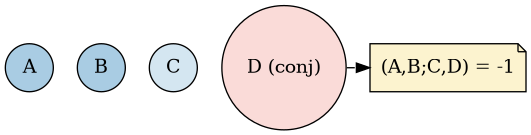
Given three collinear points A, B, C, returns the fourth point D such that (A, B; C, D) is a harmonic range.
\[ (A, B; C, D) = -1 \quad\Longrightarrow\quad D = \operatorname{parametrize}(B \cdot l_C,\; A,\; A \cdot l_C,\; B) \]
- Parameters
-
[in] A First point [in] B Second point [in] C Third point (must be collinear with A and B)
- Returns
- constexpr Point The harmonic conjugate
◆ harm_conj() [3/3]
|
constexpr |
Harmonic conjugate.
\[ (A, B; C, D) = -1 \]
- Template Parameters
-
Value Point
- Parameters
-
[in] pt_a [in] pt_b [in] pt_c
- Returns
- Point
◆ incident()
requires ProjectivePlane<Point, Line>
|
constexpr |
The code snippet is defining a function named incident that checks if a point pt_p is incident to a line ln_l in a projective plane. The function uses the dot method of the Point class and compares it to zero to determine if the point is incident to the line. The function returns a boolean value indicating whether the point is incident to the line or not.
- Parameters
-
[in] pt_p [in] ln_l
- Returns
- true
- false
◆ involution()
|
constexpr |
Involution on a point.
Applies the involution defined by origin and mirror to point pt_p.
\[ p' = \operatorname{harm\_conj}(o,\; (p \times o) \times m,\; p) \]
- Template Parameters
-
Value Point Point::Dual
- Parameters
-
[in] origin [in] mirror [in] pt_p
- Returns
- Point
◆ is_harmonic()
|
constexpr |
Check if four points form a harmonic range.
Four points A, B, C, D form a harmonic range if the cross ratio (A, B; C, D) equals -1.
- Parameters
-
[in] A First point [in] B Second point [in] C Third point [in] D Fourth point
- Returns
- constexpr auto true if harmonic, false otherwise
◆ is_parallel()
|
constexpr |
Check if two lines are parallel.
Uses the cross product of direction vectors to determine if two lines have the same direction.
- Parameters
-
[in] line_l First line [in] line_m Second line
- Returns
- true if lines are parallel, false otherwise
◆ is_perpendicular() [1/2]
|
constexpr |
Check if two lines are perpendicular (Cayley-Klein).
Uses the pole-polar relationship to check perpendicularity.
- Template Parameters
-
Line The line type Point The point type (dual of line)
◆ is_perpendicular() [2/2]
|
constexpr |
Check if two lines are perpendicular.
Uses the dot product of direction vectors to determine if two lines meet at a right angle.
- Parameters
-
[in] line_l First line [in] line_m Second line
- Returns
- true if lines are perpendicular, false otherwise
◆ join()
|
constexpr |
Return the join (product) of two points to form a line.
The join operation in projective geometry computes the line passing through two distinct points.
\[ l = p \times q \]
- Parameters
-
[in] pt_p First point [in] pt_q Second point
- Returns
- pg_line<_K> The line through the two points
◆ lcm()
|
constexpr |
Least common multiple.
\[ \operatorname{lcm}(m,n) = \frac{|m|}{|m| \bmod |n|} \cdot |n| \]
- Template Parameters
-
Mn
- Parameters
-
[in] _m [in] _n
- Returns
- Mn
◆ meet()
|
constexpr |
Return the meet (intersection) of two lines to form a point. In projective geometry, two distinct lines always intersect at a point.
\[ p = l \times m \]
◆ midpoint()
|
constexpr |
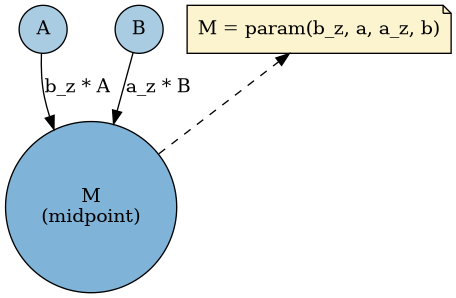
Compute the midpoint of two points.
Returns the point that divides the segment AB in the ratio 1:1.
\[ M = \operatorname{parametrize}(b_z,\; a,\; a_z,\; b) \]
- Parameters
-
[in] a First point [in] b Second point
- Returns
- Point The midpoint
◆ orthocenter() [1/2]
|
constexpr |
Compute the orthocenter of a triangle (Cayley-Klein).
Returns the intersection point of the three altitudes.
\[ H = h_{a_1} \times h_{a_2} \]
- Parameters
-
[in] triangle Array of three non-collinear points
- Returns
- std::arrary<Line, 3>
◆ orthocenter() [2/2]
|
constexpr |
Compute the orthocenter of a triangle.
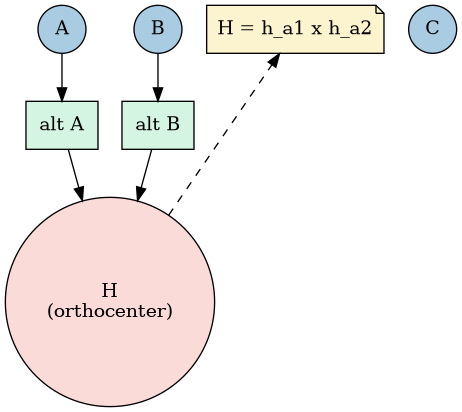
The orthocenter is the intersection point of all three altitudes of a triangle.
\[ H = h_{a_1} \times h_{a_2} \]
- Parameters
-
[in] triangle Array of three non-collinear points
- Returns
- Point The orthocenter of the triangle
◆ parametrize()
requires Ring<Value>
|
constexpr |
Homogeneous parametrization of point or line (free function)
Returns lambda * p + mu * q in homogeneous coordinates. This free function is required by the ProjectivePlaneH concept and is used by Involution and other algorithms in proj_plane.hpp.
- Template Parameters
-
Value The scalar type (coordinate type) Point The point or line type
- Parameters
-
[in] lambda First scalar coefficient [in] pt_p First point/line [in] mu Second scalar coefficient \[ \lambda p + \mu q \]
[in] pt_q Second point/line
- Returns
- Point The parametrized point/line
◆ persp() [1/2]
|
constexpr |
return whether two triangles are perspective
- Template Parameters
-
Point Point
- Parameters
-
[in] tri1 [in] tri2
- Returns
- true
- false
◆ persp() [2/2]
|
constexpr |
return whether two triangles are perspective
- Parameters
-
[in] tri1 [in] tri2
- Returns
- true
- false
◆ plucker_c()
| auto fun::plucker_c | ( | const _T & | lambda_val, |
| const std::array< _K, 3 > & | v_a, | ||
| const _T & | mu_val, | ||
| const std::array< _K, 3 > & | v_b | ||
| ) | -> std::array<_K, 3> |
generic Plücker linear combination
\[ \lambda v_a + \mu v_b \]
- Template Parameters
-
_T scalar type _K coordinate type
- Parameters
-
[in] lambda_val scalar for v_a [in] v_a first vector [in] mu_val scalar for v_b [in] v_b second vector
- Returns
- lambda_val*v_a + mu_val*v_b
◆ Ptolemy()
|
constexpr |
Check Ptolemy's theorem for a cyclic quadrilateral.
Ptolemy's theorem states that for a cyclic quadrilateral, the product of the diagonals equals the sum of the products of opposite sides.
\[ Q_{12}Q_{34} + Q_{23}Q_{14} = Q_{13}Q_{24} \]
or equivalently \(\mathrm{archimedes}(Q_{12}Q_{34},\; Q_{23}Q_{14},\; Q_{13}Q_{24}) = 0\).
- Parameters
-
[in] quad Array of six side/diagonal measurements {Q12, Q23, Q34, Q14, Q13, Q24}
- Returns
- true if the quadrilateral satisfies Ptolemy's theorem
◆ quad1() [1/2]
requires Integral<K>
|
constexpr |
Compute squared difference of ratios (integral version).
\[ \mathrm{quad}_1 = \left(\frac{x_1}{z_1} - \frac{x_2}{z_2}\right)^2 \]
- Parameters
-
[in] x1 First numerator [in] z1 First denominator [in] x2 Second numerator [in] z2 Second denominator
- Returns
- auto The squared difference of ratios
◆ quad1() [2/2]
|
constexpr |
Compute squared difference of ratios (non-integral version).
\[ \mathrm{quad}_1 = \left(\frac{x_1}{z_1} - \frac{x_2}{z_2}\right)^2 \]
- Returns
- auto The squared difference of ratios
◆ quadrance()
|
constexpr |
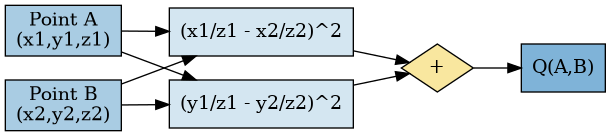
Compute the quadrance between two points.
The quadrance is the squared distance between two points in the Euclidean plane:
\[ Q(A,B) = \left(\frac{A_x}{A_z} - \frac{B_x}{B_z}\right)^2 + \left(\frac{A_y}{A_z} - \frac{B_y}{B_z}\right)^2 \]
- Parameters
-
[in] a1 First point [in] a2 Second point
- Returns
- auto The quadrance (squared distance)
◆ quadrance_copy()
|
constexpr |
Compute quadrances for multiple pairs of points.
Returns a tuple of quadrances for each pair of points.
- Parameters
-
[in] args Pairs of points
- Returns
- std::tuple of quadrance values
◆ R()
|
constexpr |
Compute the cross ratio of four collinear points.
Compute the cross ratio using projective construction.
Returns the cross ratio \(R(A, B; C, D)\) of four points on a line. Automatically chooses the best coordinate projection based on the points.
In homogeneous coordinates:
\[ R(A,B;C,D) = \frac{\mathrm{cross}_k(A,C)}{\mathrm{cross}_k(A,D)} \Big/ \frac{\mathrm{cross}_k(B,C)}{\mathrm{cross}_k(B,D)} \]
where \(k\) is chosen (0 or 1) to avoid degenerate projections.
- Parameters
-
[in] A First point [in] B Second point [in] C Third point [in] D Fourth point
- Returns
- constexpr auto The cross ratio
Returns the cross ratio R(A, B; C, D) using a projective construction that works with arbitrary projective planes.
- Returns
- constexpr auto The cross ratio
◆ R0()
|
constexpr |
Compute cross ratio using yz-plane projection.
Returns the cross ratio R(A, B; C, D) using the yz-plane projection.
\[ R_0(A,B;C,D) = \frac{\mathrm{cross}_0(A,C)}{\mathrm{cross}_0(A,D)} \Big/ \frac{\mathrm{cross}_0(B,C)}{\mathrm{cross}_0(B,D)} \]
- Parameters
-
[in] A First point [in] B Second point [in] C Third point [in] D Fourth point
- Returns
- constexpr auto The cross ratio
◆ R1()
|
constexpr |
Compute cross ratio using xz-plane projection.
Returns the cross ratio R(A, B; C, D) using the xz-plane projection.
\[ R_1(A,B;C,D) = \frac{\mathrm{cross}_1(A,C)}{\mathrm{cross}_1(A,D)} \Big/ \frac{\mathrm{cross}_1(B,C)}{\mathrm{cross}_1(B,D)} \]
- Parameters
-
[in] A First point [in] B Second point [in] C Third point [in] D Fourth point
- Returns
- constexpr auto The cross ratio
◆ ratio_ratio()
|
constexpr |
Compute the ratio of two ratios.
\[ \frac{a/b}{c/d} = \frac{ad}{bc} \]
- Parameters
-
[in] a First numerator [in] b First denominator [in] c Second numerator [in] d Second denominator
- Returns
- auto The ratio of ratios
◆ reflect() [1/2]
|
constexpr |
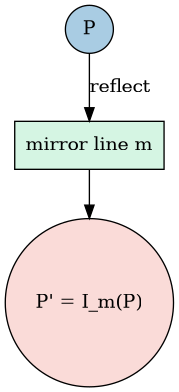
Create an involution that reflects across a line.
Returns an involution that performs reflection across the given line in the Euclidean plane.
\[ I_m(p) = \operatorname{Involution}(m,\; \bar{m}) \]
where \(\bar{m}\) is the direction vector of the mirror line.
- Parameters
-
[in] line_m The line of reflection (mirror)
- Returns
- Involution The reflection involution
◆ reflect() [2/2]
|
constexpr |
Reflect a point across a line (Cayley-Klein).
Uses involution to reflect a point across a mirror line.
\[ p' = \operatorname{involution}(m^\perp,\; m,\; p) \]
where \(m^\perp\) is the pole of the mirror line.
- Parameters
-
[in] mirror The line of reflection [in] pt_p The point to reflect
- Returns
- Point The reflected point
◆ sbase()
|
constexpr |
Base function for spread and cross-spread.
\[ \mathrm{sbase}(l_1, l_2, d) = \frac{d^2}{\mathrm{dot}_1(l_1,l_1)\,\mathrm{dot}_1(l_2,l_2)} \]
- Parameters
-
[in] l1 First line [in] l2 Second line [in] d Scalar value (cross or dot product)
- Returns
- auto
◆ spread()
|
constexpr |
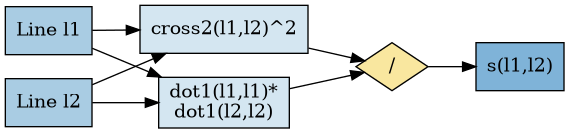
Compute the spread between two lines.
The spread is the squared sine of the angle between two lines:
\[ s(l_1, l_2) = \frac{\mathrm{cross}_2(l_1, l_2)^2} {\mathrm{dot}_1(l_1, l_1) \mathrm{dot}_1(l_2, l_2)} \]
- Parameters
-
[in] l1 First line [in] l2 Second line
- Returns
- auto The spread
◆ sq()
|
constexpr |
Square function.
\[ \mathrm{sq}(a) = a^2 \]
- Template Parameters
-
T data type
- Parameters
-
[in] a input value
- Returns
- a^2
◆ tri_altitude() [1/2]
|
constexpr |
Compute all three altitudes of a triangle (Cayley-Klein).
Returns an array containing the three altitude lines.
\[ \{h_{a_1},\; h_{a_2},\; h_{a_3}\} \]
- Parameters
-
[in] triangle Array of three non-collinear points
- Returns
- std::arrary<Line, 3> Array of three altitude lines
◆ tri_altitude() [2/2]
|
constexpr |
Compute all three altitudes of a triangle.
Returns an array containing the three altitude lines of the triangle.
\[ \{h_{a_1},\; h_{a_2},\; h_{a_3}\} \]
- Parameters
-
[in] triangle Array of three non-collinear points
- Returns
- std::array<Line, 3> The three altitude lines
◆ tri_dual() [1/2]
|
constexpr |
Dual of triangle.
\[ \{l_1, l_2, l_3\} = \{a_2 \times a_3,\; a_1 \times a_3,\; a_1 \times a_2\} \]
- Template Parameters
-
Point Point Line Line
- Parameters
-
[in] triangle
- Returns
- std::array<Line, 3>
◆ tri_dual() [2/2]
|
constexpr |
Compute the dual triangle (sides as points).
Returns the triangle formed by the three lines joining the vertices of the input triangle.
\[ \{l_1, l_2, l_3\} = \{a_2 \times a_3,\; a_1 \times a_3,\; a_1 \times a_2\} \]
- Parameters
-
[in] triangle Array of three non-collinear points
- Returns
- auto Array of three lines (the sides)
◆ tri_func()
|
constexpr |
Apply a binary function to all pairs of triangle vertices.
Returns an array with the function applied to each pair of distinct vertices of the triangle.
- Parameters
-
[in] func A binary function to apply [in] triangle Array of three points
- Returns
- auto Array of three results
◆ tri_midpoint()
|
constexpr |
Compute the midpoints of all three sides of a triangle.
Returns an array containing the midpoints of each side of the triangle.
\[ \{M_{a_1a_2},\; M_{a_2a_3},\; M_{a_1a_3}\} \]
- Parameters
-
[in] triangle Array of three points
- Returns
- Triple<Point> Array of three midpoints
◆ tri_quadrance()
|
constexpr |
Compute the quadrances of a triangle's sides.
Returns an array with the quadrances of the three sides of the triangle.
- Parameters
-
[in] triangle Array of three points
- Returns
- auto Array of three quadrance values
◆ tri_spread()
|
constexpr |
Compute the spreads of a triangle's angles.
Returns an array with the spreads of the three angles of the triangle.
- Parameters
-
[in] trilateral Array of three lines
- Returns
- auto Array of three spread values
◆ uc_point()
|
constexpr |
Compute a point on the unit circle from trigonometric parameters.
Creates a point on the unit circle using the parameterization (lambda^2 - mu^2, 2*lambda*mu, lambda^2 + mu^2).
\[ (\lambda^2 - \mu^2,\; 2\lambda\mu,\; \lambda^2 + \mu^2) \]
- Parameters
-
[in] lda1 The lambda parameter [in] mu1 The mu parameter
- Returns
- Point A point on the unit circle
◆ x_ratio()
requires ProjectivePlane<Point, Line>
|
constexpr |
Cross Ratio.
The cross ratio of four points with respect to two lines:
\[ R(A,B;l,m) = \frac{A \cdot l}{A \cdot m} \Big/ \frac{B \cdot l}{B \cdot m} \]
- Template Parameters
-
Point Line
- Parameters
-
[in] A point A [in] B point B [in] line_l line l [in] line_m line m
- Returns
- cross ratio R(A,B;line_l,line_m)
- Todo:
- rewrite by projecting to the y-axis first [:2]